Portable Traffic Signals – Key Requirements (Fact Sheet)
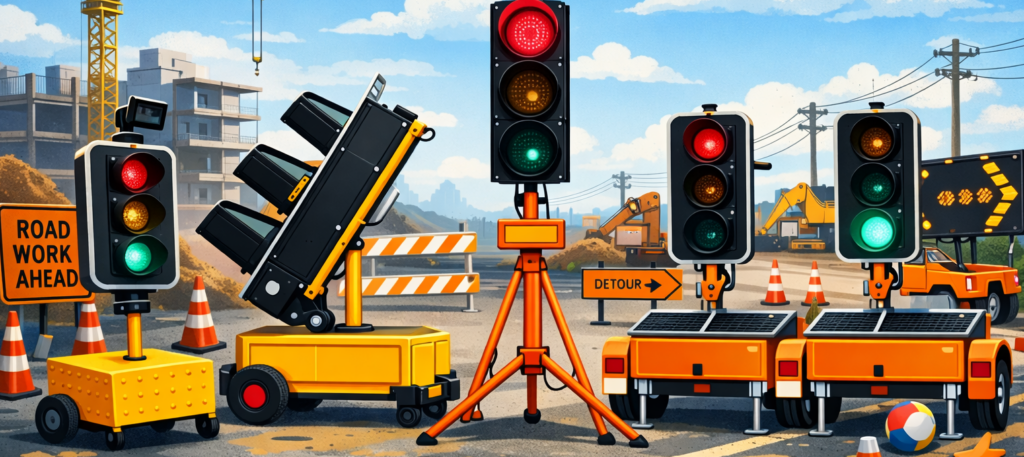
Portable traffic signals are an essential control measure for managing single‑lane shuttle operations, temporary intersections, and constrained work zones. In New Zealand, their use is governed by AS 4191:1994, the Land Transport Rule: Traffic Control Devices 2004, and the risk‑based principles of NZGTTM.
This fact sheet summarises the mandatory physical, operational, and signage requirements for compliant deployment.
1. Compliance Framework
Portable traffic signals used in New Zealand must:
- Comply with AS 4191:1994 – Portable Traffic Signal Systems
- Be listed on the NZTA register of approved systems
- Be authorised through an RCA‑approved Traffic Management Plan (TMP)
- Operate in accordance with NZGTTM risk‑based principles
Only systems meeting these requirements may be used on public roads.
2. Signal Head Requirements
Standard Aspects
- Three‑aspect arrangement: Red / Yellow / Green
- Circular lenses only (arrows require specific approval)
- No flashing red or green indications (except fail‑safe yellow)
Lens Size
- 200 mm diameter lenses (industry standard)
- Must meet visibility distance requirements for the speed environment
Height
- Minimum: 1.0 m to the bottom of the lowest lens
- Typical: 1.5–2.2 m to the centre of the red aspect
- Must remain visible above vehicles, cones, and plant
Backing Board
- Black, matte, high‑contrast backing board
- Sized to provide a clear silhouette around the lenses
- Reduces sun‑washout and improves daytime visibility
Visibility & Brightness
- Must be visible in full daylight and at night
- Automatic or manual brightness control
- No ghosting or false indications
- Must be visible from the required stopping distance (typically 60–100 m)
3. Placement Requirements
Orientation
- Signal head must face squarely down the lane
- Must not conflict with permanent signals (bag, cover, or isolate if required)
Stop Position
- A defined stop point is mandatory
- If no painted stop line exists, a STOP HERE ON RED sign must be used
- Signal must be clearly visible from the stop position
Spacing
- Adequate sight distance between the warning sign and the signal
- Correct separation between opposing signals in shuttle mode
- Ensure no obstructions (plant, barriers, vehicles)
4. Required Signage
Advance Warning Sign (choose one)
One of the following must be installed before the signalised control:
- TRAFFIC SIGNALS AHEAD (TW‑15)
- PORTABLE TRAFFIC SIGNALS AHEAD (TW‑15.1)
Stop‑Line Sign (mandatory)
- STOP HERE ON RED (R1‑2)
- Defines the legal stop position
- Required where no painted stop line exists
Not required
- STOP ON RED SIGNAL (R1‑1) – intended for permanent intersections only
5. Operational Requirements
Communication
- Reliable communication between signal units (radio, cable, or approved wireless)
- Loss of communication must trigger a safe shutdown
Power
- Battery, solar, or hybrid systems permitted
- Must maintain continuous operation for the duration of the worksite
- Power levels must be checked as part of daily inspections
Fail‑Safe Behaviour
If the system detects:
- Communication loss
- Lamp failure
- Power failure
- Internal fault
It must default to:
- Flashing yellow, or
- All‑off with manual STOP/GO control
This is a strict AS 4191 requirement.
6. Daily Inspection Checklist
- Signal heads clean, visible, and correctly aligned
- Backing boards fitted and unobstructed
- Warning sign installed at correct distance
- STOP HERE ON RED sign in place
- Communication link confirmed
- Batteries/solar charging verified
- Fail‑safe tested
- Permanent signals bagged or isolated
- No obstructions to sight lines
7. Summary
Portable traffic signals provide a safe, controlled method for managing temporary traffic flows. Compliance with AS 4191, NZTA approval, and NZGTTM ensures:
- Clear driver expectations
- Reliable operation
- Defined stop positions
- Safe fallback behaviour
- Consistent national practice
RISS supports contractors, RCAs, and project teams with audit‑ready guidance, TMP support, and technical assurance for compliant portable signal deployment.
| Source | Purpose |
|---|---|
| AS 4191:1994 – Portable Traffic Signal Systems | Defines the technical and operational requirements for portable signals (aspect size, fail‑safe behaviour, communication, visibility). |
| Land Transport Rule: Traffic Control Devices 2004 (NZ) | Establishes legal requirements for signs, markings, and signal use on public roads. |
| NZTA Register of Approved Portable Traffic Signal Systems | Confirms which models are approved for use in New Zealand (e.g., BarrowLIGHT V2, Bartco CS‑200, A1 Roadlines PTC‑1000, MPB 4000/3400). |
| NZGTTM (New Zealand Guide to Temporary Traffic Management) | Provides the current risk‑based framework replacing CoPTTM, including TMP approval and RCA authorisation processes. |